

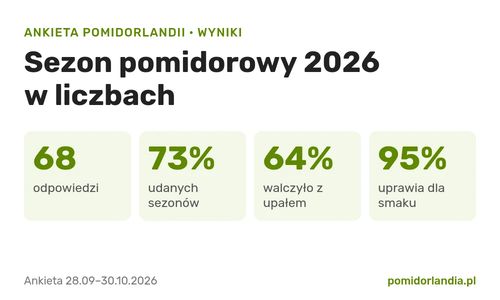
A heatwave that troubled almost everyone — and yet a good season for three out of four growers. That is the first edition of our tomato-growing survey in a nutshell. Between 28 September and 30 October, 68 people answered our questions — thank you all for your time, your honesty and a wealth of practical observations.
We went through every answer, counted the results and looked for links between them. Below are the most interesting findings: who took part, what made this season difficult, which varieties won people's hearts and what lessons are worth taking into the plans for 2027.
This is not a representative study of all gardeners. It is the voice of people who truly love tomatoes — many have grown them for years and count their varieties in dozens. That makes their experience all the more valuable.
Who took part in the survey?
Above all, experienced enthusiasts. Only three people had just finished their first season, and almost one in four has been growing tomatoes for more than ten years. Most do not stop at a few plants:
- 76% planted 21 to 80 tomato plants, and another 13% even more;
- 70% grew at least 11 varieties, and 18% — more than 40;
- 91% raised their seedlings from their own sowing;
- 64% grew tomatoes in a home garden, one in four on an allotment and one in six on a balcony or terrace.
Tomatoes grew without any cover (63% of respondents) as well as in greenhouses (43%) and polytunnels (34%) — many people combine these methods. The same goes for growing media: 69% planted directly in the ground and 61% (also) in pots and grow bags. Half of the gardens were in the countryside, and most answers came from the Mazowieckie, Śląskie and Małopolskie regions of Poland.
How did the 2026 season go?
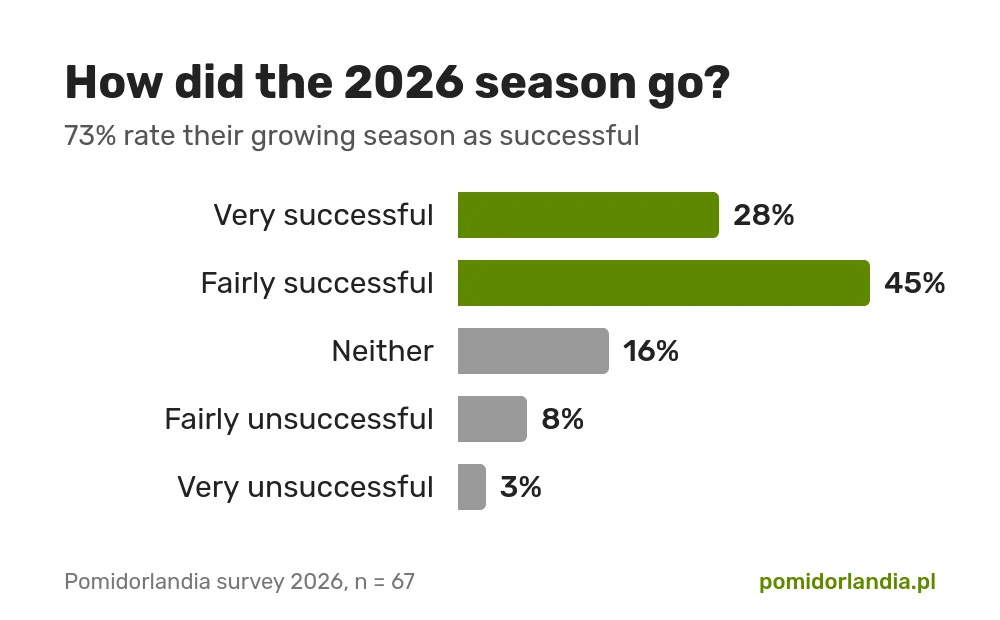
Well — despite everything. 73% rated their growing season as fairly or very successful, 16% as average and 10% as unsuccessful. When they filled in the survey, 70% were still harvesting, so some of these ratings are impressions straight from the garden.
What caused the most trouble?
Without a doubt, the heat — named by 64% of respondents. Next came poor fruit set (37%), diseases (33%), late or uneven ripening (27%), cold and frost (24%) and fruit cracking (22%). Only five people said there were no major problems this year.
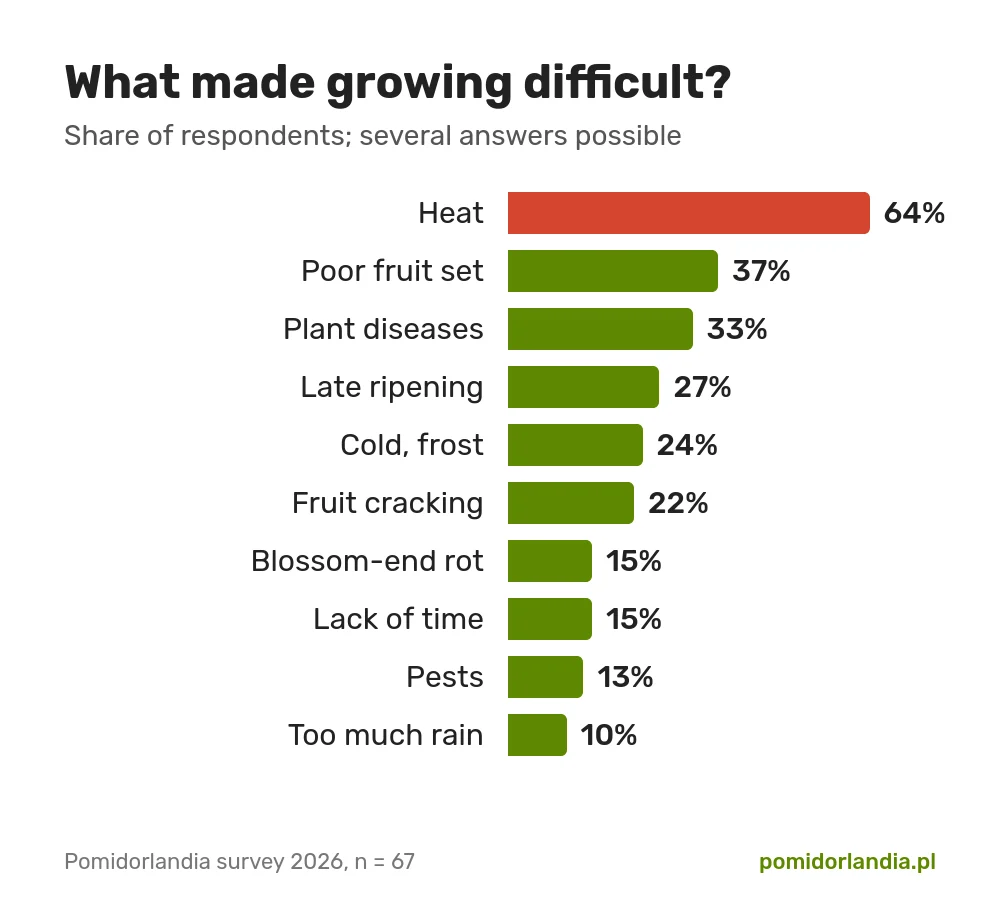
Interestingly, heat and cold often appear in the same answers. The 2026 season was fickle: many describe soil that stayed cold long after winter, then heatwaves, and at the end cold, damp nights that forced them to pick some fruit green.
What goes with what? Patterns in the survey
The most interesting part of the analysis is looking for links between answers. With 68 responses we treat them as hints rather than hard rules — and correlation does not mean causation. Still, a few patterns are clear.
1. A season is spoilt by problems piling up, not by a single one
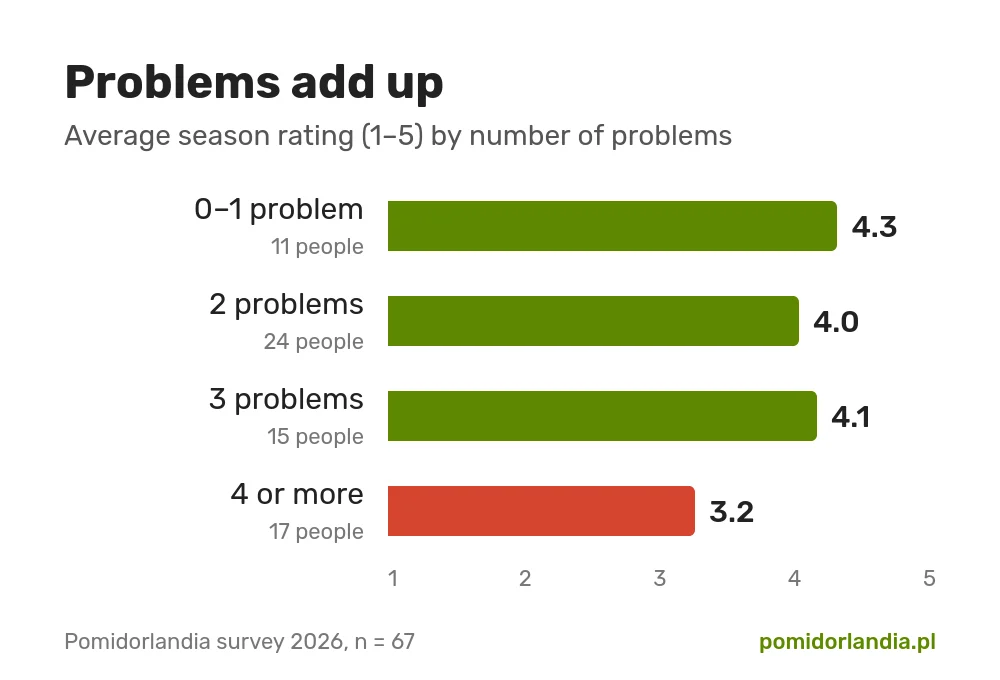
The average season rating (on a scale from 1 to 5) was about 4.1 among people who named up to three problems. Among those with four or more problems it fell to 3.2. Tomatoes cope well with one setback — the trouble starts when heat is joined by diseases, poor fruit set and cracking.
2. Heat affected almost everyone, but poor fruit set lowered the ratings most
People who struggled with heat rated their season 3.9 on average — the same as all respondents. Heat was simply the common backdrop of this year. Clearly lower ratings (3.4) came from those whose plants set fruit poorly or suffered from blossom-end rot. Both problems often share a common cause: high temperatures and uneven watering.
3. The heat paradox: problem number one, yet hardly anyone thinks of it when choosing varieties
This may be the most surprising finding. Heat made growing harder for 64% of respondents, but only 7.5% consider good fruiting in hot weather when choosing varieties. The same goes for cracking: it affected 22% of gardens, while crack resistance matters to 3% of people. Diseases are the opposite — resistance matters to many (58%), more than this year's troubles (33%) would suggest.
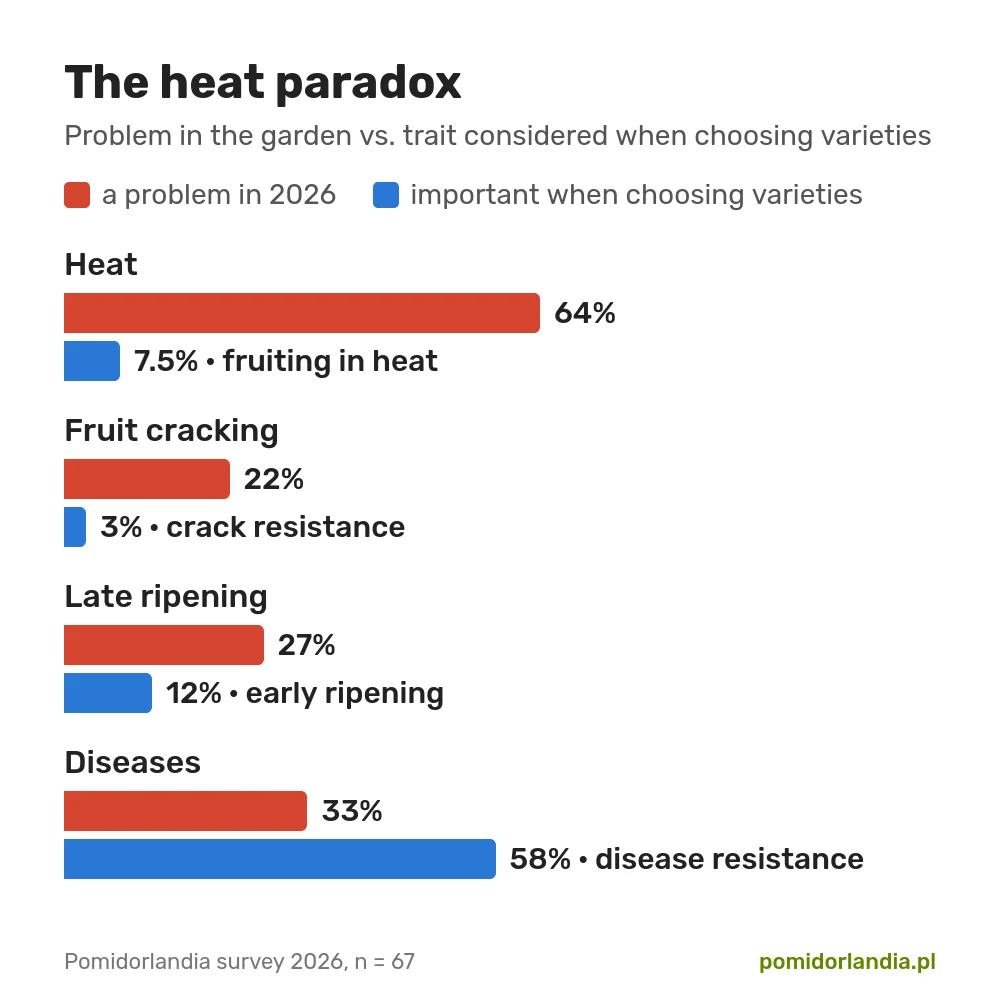
Taste will of course always come first — 94% named it. But if the coming years are similar, it is worth having at least a few varieties on the list that set fruit well on hot days.
4. Cover did not change the overall rating, but it changed the kind of problems
Growers without cover, in polytunnels and in greenhouses rated the season almost identically (3.9–4.0). The differences are in the details: without cover too much rain (17% vs. 6%) and fruit cracking (24% vs. 16%) were more common, while under cover diseases (37% vs. 31%) and blossom-end rot appeared slightly more often. The comments keep repeating the same advice: in hot weather, open greenhouses and polytunnels, shade them and keep the air moving.
5. Experience pays off
The highest ratings came from the most experienced growers: 4.2 with 11–20 seasons and 4.4 with more than 20, compared with 3.6–3.7 for 4–10 seasons. Experience also comes with a larger scale (more plants) and the habit of saving one's own seeds. Those who grow more plants also grow more varieties — the strongest link in the whole survey. Tomatoes are simply addictive.
6. Plant protection: the best ratings when home remedies are combined with ready-made organic products
People who use ready-made products approved for organic growing in addition to home remedies rated their season 4.5 on average. Those relying only on home methods — 3.6. This is a small group (11 people), so we treat it as a curiosity to check again next year rather than a recommendation.
7. Weather is one thing, seeds are another
The season rating was only weakly linked to the rating of our seeds — even people whose season did not go well usually rated the seeds highly. Satisfaction with the seeds, on the other hand, clearly translated into willingness to recommend the shop. Thank you for making that distinction: we cannot change the weather, but we are fully responsible for the quality of our seeds.
Why do we grow tomatoes?
For the taste of home-grown fruit — 95%. Almost half also named the pleasure and relaxation of being among plants (49%) and discovering and collecting varieties (46%). Nobody chose saving money — which says a lot about this hobby.
Continuity matters too: 64% save seeds from their own tomatoes (34% regularly), and another 19% want to try. Almost half of those who sow also used seeds from their own harvest this year.
The varieties that won hearts in 2026
We asked which variety everyone most wants to plant again. The answers varied widely — many could not choose just one and named several. These came up most often:
- Aussie — the clear favourite, named 7 times;
- Siberian Tiger and Pink Siberian Tiger — 4 mentions together;
- Green Tiger — praised as reliable and delicious;
- Malachite Box — surprised not only the gardeners but also their families and friends with its looks and taste;
- Mama Irene's and Cuore Antico Di Acqui Therme — 3 mentions each;
- Candy Stripe, Uluru Ochre, Black Cherry and Blush — 2 mentions each.
Coyote also deserves a special mention — one respondent, despite a love for large, meaty tomatoes, described it as the variety that stole their heart with its taste, resilience and fruiting right up to the first frosts. Another recommends Semipalatinsk as a hardy and tasty choice for next year.
Tips from gardeners for gardeners
We asked for one observation from this year's growing. Here are the conclusions that came up most often (in our own words):
- Shade and mulch in hot weather. Shade cloth on the greenhouse or polytunnel and mulch — especially for tomatoes in pots — are the basics.
- Airflow works wonders. An open, well-ventilated greenhouse means fewer diseases and pests; not every spot on a leaf means the worst.
- Consistency wins. Regular organic sprays every few days and after rain, even watering — ideally with an irrigation system.
- Sow early and use grow lights. If you want to eat your own tomatoes in August, sow by mid-February.
- Check the soil temperature before planting out — this year the soil stayed cold for a long time despite warm days.
- Healthy, rich soil is the foundation. Several people praise their own compost, bokashi and microbial products.
- Nasturtiums as a “lookout”. Pests often attack them first, which helps to spot them sooner.
- Don't give up. This appeal came up again and again: even after a difficult season, the taste, colour and scent of your own tomatoes are worth the effort.
How do you rate Pomidorlandia?
This part mattered to us a lot. You rated our seeds 4.75 on a scale from 1 to 5 on average (77% “very satisfied”). When asked whether they would recommend the shop to friends, 50 of 57 people gave 9 or 10, which means a Net Promoter Score of 82.
The reasons given most often were a huge choice of varieties, high germination rates, true-to-type varieties, reliable descriptions and genuine photos, and contact with us. We have also noted the critical remarks: occasional variety mix-ups, weaker germination of some batches and seedlings that some people found weakened. Twelve people rated our seedlings — 4.1 on average. We take this to heart and are working on it.
Plans for 2027
Nobody intends to give up tomatoes. 72% plan to grow on a similar scale, 15% want to plant more and 13% a little less (which, as you write yourselves, you promise yourselves every year…).
Finally: see you next year!
The first edition of the survey showed how much knowledge is shared among you — from shading greenhouses to nasturtiums as an early pest warning. Every answer helps us choose varieties better, describe them better and plan the coming seasons.
The second edition of the survey will start in autumn 2027. We warmly invite you to take part — and to take notes throughout the season: what worked, what surprised you and which variety deserves a place next year. The more people answer, the more interesting the conclusions — perhaps next year we will check whether heat-tolerant varieties really do better?
Thank you once again to all 68 participants. See you in the garden — and in the 2027 survey!
About the survey: anonymous online survey, answers collected from 28 September to 30 October 2026, 68 valid responses (67 people grew tomatoes in 2026). Percentages are calculated from those who answered a given question; in multiple-choice questions they do not add up to 100%. Patterns are described using averages and rank correlations; with such a small group we treat them as indications. Open answers are summarised in our own words, without any information that could identify their authors.