Rutgers
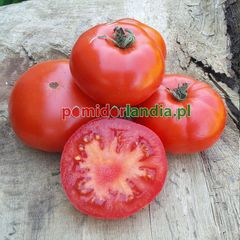
is one of the classic, older commercial tomato varieties, introduced to the market in 1934 by the New Jersey Agricultural Experiment Station in collaboration with Campbell Soup Company. It was developed to meet the needs of the canning industry, but over time it has also become popular for home gardens. The fruits of this variety range in shape from round to slightly flattened; they are uniform in size and typically weigh 170–190 g.
The skin is deep red, smooth, and resistant to cracking, making them ideal for canning but also for fresh consumption. Although the skin is thin, the fruit is excellent for processing—including the production of sauces and ketchup—and works great in salads as well.
The “
Rutgers
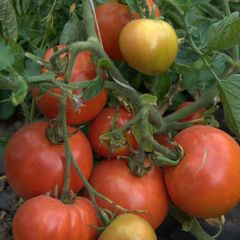
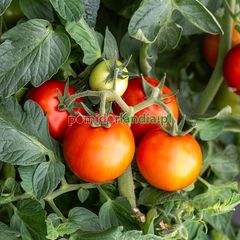
” variety offered by our farm is a determinate variety. It is a relatively early-maturing variety—the first fruits can be harvested about 70–80 days after planting in their permanent location. The plant is characterized by vigorous growth.
Rutgers is widely used in the food industry but is also prized for its flavor—its balance of sweetness and acidity makes it suitable for eating raw, as well as for cooking or canning. This variety was one of the most important on the American market in the mid-20th century, and its history inspired the re-crossing of its parent varieties, Marglobe and J.T.D. This led to the creation of a distinct variety, “
Rutgers
250,” introduced in 2016 to commemorate the university’s 250th anniversary.
Lyman Schermerhorn was responsible for the selection of the classic “Rutgers.” He received planting material from a cross conducted by the Campbell Soup Company in 1928, and after several years of testing, the variety was made available in 1934. This tomato, familiar from home gardens, thus also has a chapter in its history linked to American tomato soup.