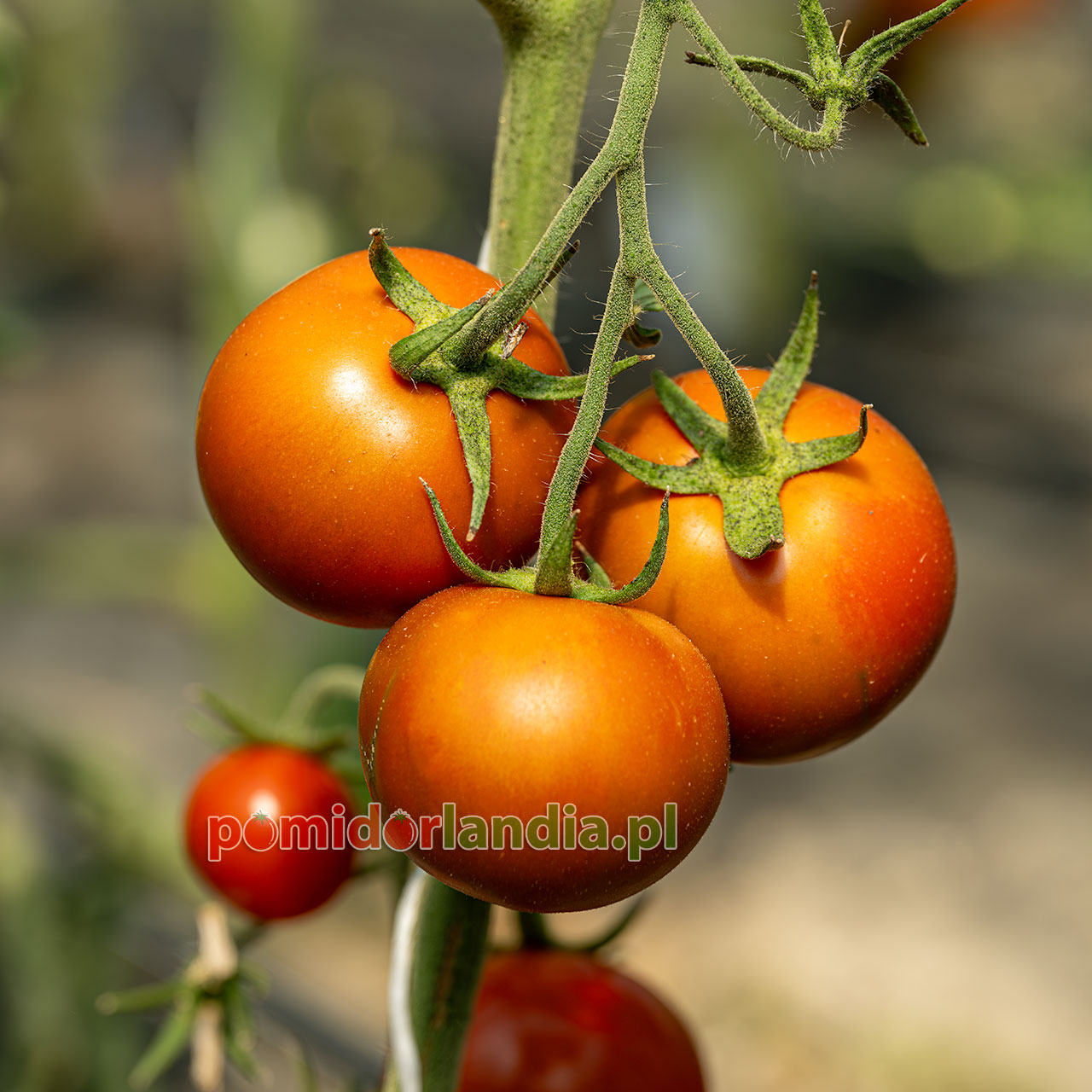
Jointless
Jointless – a stem without a “knee
.” Jointless is a trait in tomatoes characterized by the absence of a properly developed abscission zone on the flower stalk. In most varieties, a characteristic thickening, known as a “joint,” is visible in the middle of the pedicel. Within this thickening lies the separation zone—a specialized layer of cells that allows the flower or fruit to be separated from the plant.
In jointless tomatoes, this zone does not develop properly. During harvest, the fruit therefore usually detaches at the calyx, while the peduncle and calyx lobes remain on the plant. The harvested tomato is free of green parts.
Practical
Significance
The “jointless” trait has played an important role primarily in the breeding of tomatoes intended for processing and mechanical harvesting. Stalks remaining attached to the fruit can pierce or damage adjacent tomatoes during harvesting, transport, and processing. Their absence reduces such damage and eliminates the need to separate stalks and calyxes at the processing plant.
‘Jointless’ can also be useful in hobby gardening and for manual harvesting. Fruits are easier to pick without stalks, which is particularly convenient for varieties intended for sauces, purees, juices, and other preserves.
However, the absence of a joint does not mean that ripe fruit falls from the plant on its own. On the contrary—since the typical detachment zone on the stalk is not formed, the flowers and fruit do not detach at this point in the usual way.
History of the Discovery
The first mutation causing the absence of a joint was described by L. Butler in 1936. It was named “jointless” and given the symbol “j”; today it is also sometimes referred to as “jointless-1” or “j1” to distinguish it from a second, genetically independent source of this trait.
In 1956, Charles M. Rick described another mutation found in a wild tomato native to the Galápagos Islands. It was given the symbol j2 or j-2, from “jointless-2.” This material is currently associated with the species Solanum cheesmaniae.
An independent source of the j2 mutation also appeared in the cultivated tomato. In 1958, a single plant with an expanded inflorescence and pedicels without joints was found in variety number 146. Studies showed that the trait was caused by an allele of the same j2 gene that had previously been found in material from the Galápagos. The results were published by G.B. Reynard in the journal *Science* in 1961.
Genetics
Jointless is not a single mutation. At least two independent loci can cause a very similar absence of the abscission zone:
JOINTLESS (J) is located on chromosome 11. This gene encodes a transcription factor from the MADS-box family, involved in the development of the abscission zone and the inflorescence. The deletion described in the classic mutant leads to loss of gene function. The recessive allele j causes the absence of the joint, but it also induces adverse changes in inflorescence structure, including a return to vegetative growth. The resulting reduction in flower number and yield meant that this allele was of little significance in commercial breeding.
JOINTLESS2 (J2) is located on chromosome 12 and corresponds to the Solyc12g038510 gene, also known as SlMBP21. It, too, encodes a MADS-box-type transcription factor. Natural j2 alleles are loss-of-function mutations. In material from the Galápagos, a mutation creating a premature stop codon was identified, while in the second allele, derived from a cultivated tomato, a Rider retrotransposon insertion was detected. The recessive j2 allele has been widely used in breeding, particularly for industrial tomatoes.
The j2 effect also depends on the other genes present in a given variety. The related gene ENHANCER OF JOINTLESS2 (EJ2) is particularly important. The combination of certain j2 and ej2 variants can cause excessive branching of inflorescences, a large number of flowers, and reduced fruit set. Breeders must therefore evaluate the jointless trait within a specific genetic background, rather than solely based on the presence of the j2 allele itself.
Jointless and Genetic
Modification
The natural j and j2 alleles arose as spontaneous mutations and were introduced into varieties through classical breeding methods. The mere presence of the “jointless” trait does not, therefore, mean that a variety is a genetically modified organism. In scientific studies, “jointless” plants have also been produced by editing the J2 gene using the CRISPR/Cas9 method, but this is a separate source of the same trait.
In short: “jointless” refers to the absence of a functional joint on the stem. This trait allows for harvesting fruit without stems or calyxes, which is why it has become particularly important in the breeding of tomatoes for mechanical harvesting and processing.
On our farm, we grow two such varieties: Alaskan Fancy
and Creme Brulee
.