

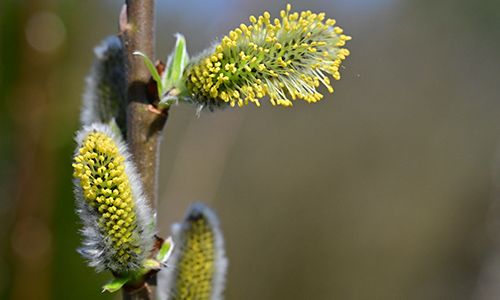
This April is one of the warmest we can remember and is the complete opposite of last year’s. Back then (here), there were literally only 5–6 days without frost; this year, it’s the opposite: practically no frost, pleasant spring weather, and the singing of countless birds—and very soon, the amphibians living in our pond will begin their mating season. On top of that, the seedlings are growing beautifully; we’re slowly finishing up labeling them and are already looking forward to May. And in May—a few important changes:
1. Seeds – Summer Break
Just like last year—seeds are available for purchase only through the end of April. On May 1, sales pause until the release of the new catalog on October 1. If you want to stock up—you have less and less time to do so. Starting June 1, we’ll completely suspend sales and focus solely on cultivation—the summer break begins.
2. May: Seedlings
We’re rapidly approaching the start of seedling shipments. As we do every year, customers who have purchased seedlings will be informed about shipping progress, any delays, or changes via separate emails sent exclusively to them. After discussions with the shipping carrier and many emails from you, we’ve decided to postpone this year’s shipments to May 8. The original plan was to begin shipments on May 4 (Thursday). On that day, the smallest orders—12 items each—were to be shipped so that even if they remained at the carrier’s sorting facility, the loss would not be as severe. However, thanks to a favorable calendar alignment, this year’s long weekend has turned into quite a long vacation. By taking just two days of vacation (May 4 and 5), we have as many as 9 days off (April 29–May 7). It’s no surprise that many people are taking advantage of this time; companies will have fewer staff on duty, which shouldn’t (but might) cause, for example, delays in deliveries. And that’s something we really, really want to avoid. That’s why we’re planning the first shipments for May 8—in the order in which orders were placed (or as per individual arrangements).


 Catalog
3. Ban on Seed Sales / Brussels

This topic has been on the minds of interested gardeners and farmers for over a year. It is not merely a local issue—it affects many European Union countries. Although countries such as Austria, Germany, France, Belgium, Denmark, Estonia, Latvia, and several others support initiatives similar to Pomidorlandia, there is also a second bloc where corporate interests call the shots. Poland stands out as a disgraceful example among EU countries—our Ministry of Agriculture fights for the rights of corporations with the fervor of Rejtan tearing his shirt, completely ignoring the interests of consumers and small producers.

At the end of March, I attended two conferences in Brussels. The first, organized by the Austrian organization Arche Noach (Noah’s Ark), was a gathering of people from nearly all over Europe (though there was also a friendly doctoral student from Nepal), including gardeners, farmers, and lawyers—during this conference, we had the opportunity to exchange experiences, learn about the workings of the European Parliament, the current status of work on the new EU Seed Directive, and meet the assistant to one of the MEPs. To wrap things up, we visited the European Parliament, where we learned about its history and saw firsthand where MEPs work.

On the third day, another conference took place—organized by the second-largest organization representing over 200 million (!) farmers from around the world: La Via Campesina. One of this organization’s greatest achievements is the inclusion of the right to seeds in the UN Charter of Human Rights (Article 19, the famous so-called UNDROP, or “United Nations Declaration on the Rights of Peasants”). The conference was attended by two Members of the European Parliament (Benoit Biteau and Eric Andrieu), representatives of the European Commission (Irene Sacristan Sanchez and Paivi Mannerkorpi (DG SANTE), Jean Ferriere (DG AGRI)), and the meeting was moderated by Ms. Cloe Mathurin (ECVC). The aim of the conference was to present to the European Commission the risks posed by the introduction of NGT (New Genomic Techniques—a term used by corporations to distance themselves from GMOs, but which is in fact exactly the same thing, only “much more” so.) Why was this topic important to us? Well, the new EU seed directive will be introduced alongside (and even in the shadow of) the NGT directive. Initially, the directive was to be presented on June 7, but due to the complexity of the issue, it was postponed to the third quarter of this year.
Contrary to appearances, the change in the publication date for the proposed directives (“Seed” and NGT) is actually a very good thing. If the publication deadline had been maintained, given the progress of work on the document and the European Parliament’s schedule, there would have been a huge risk that the vote would have taken place during Poland’s EU presidency (first half of 2025). All participants at both conferences expressed significant concerns regarding this. Given the position of the Polish Ministry of Agriculture and Rural Development, it is certain that not only would the NGT Directive have been adopted, but further restrictions on the trade in seed material would also have been introduced. In light of the above, the postponement of these efforts appears to be the first positive sign in the fight to protect the interests of farmers and gardeners.
4. Petition to the Minister of Agriculture
Returning to our own Polish context—the fight for seeds continues. To be more precise—we are fighting for the right of farmers to sell seeds directly to end users (gardeners and allotment holders). At present, the Ministry of Agriculture is valiantly defending the interests of corporations and importers, treating companies like our farm as—brace yourselves—thieves (literally) of intellectual property rights. All the while, it pays no attention to the interests of gardeners or farmers, the preservation of biodiversity, the preservation of the oldest varieties, or the improvement of living conditions for the smallest farms—all while clearly violating the provisions of the 2002 EU directive and—just as importantly—violating human rights. Of course, what does respect for the law mean to our ministry? Everyone can answer that question for themselves. In any case, our petition is still open, and we’re continuing to collect signatures. So far, 1,077 people have supported the cause! We plan to submit the petition to the Minister in mid-June. However, every additional signature counts—if you haven’t signed yet, please do so now:
5. Google Reviews
I also have a small request for all of you. In business, there’s a simple rule: one satisfied customer equals one new customer, and one dissatisfied customer equals ten lost customers. It’s also no surprise that we’re much more likely to post negative reviews about various services or products. If we’re satisfied, we usually keep it to ourselves. But if we’re dissatisfied, we’re much more likely to write about it—even just out of spite. Negative comments are also often used in the battle for market share by unfair competitors. After this lengthy introduction—a request: please take a minute to rate our company—honestly and specifically. If you’re satisfied, write about it; if not, write at least a short sentence. To leave a review and rate our work, all you need is a Google account (e.g., Gmail). Click on the link below, and then look for the “Leave a review” button on the left. Thank you in advance!